
How We Built an Autonomous AI Insurance Broker That Finds the Best Deal For You

Published on 18th February 2026
by the Jointly AI Team
Insurance shopping is broken. Getting the best deal means calling provider after provider, sitting on hold, repeating the same details, and then somehow comparing a stack of incomparable quotes. It takes hours of your day for a task that nobody enjoys.
We asked a simple question: what if AI could do the entire thing for you?
Not just search a comparison site. Not just fill out a form. We mean the whole thing - have a conversation with you to understand what you need, research the market, pick up the phone and call insurers, negotiate quotes, analyse the results, and call you back with a clear recommendation.
That's what we built at Jointly AI - a brand new offering for Insurance Brokers. And in this post, we'll pull back the curtain on the AI architecture that makes it possible.
The Five-Agent Pipeline
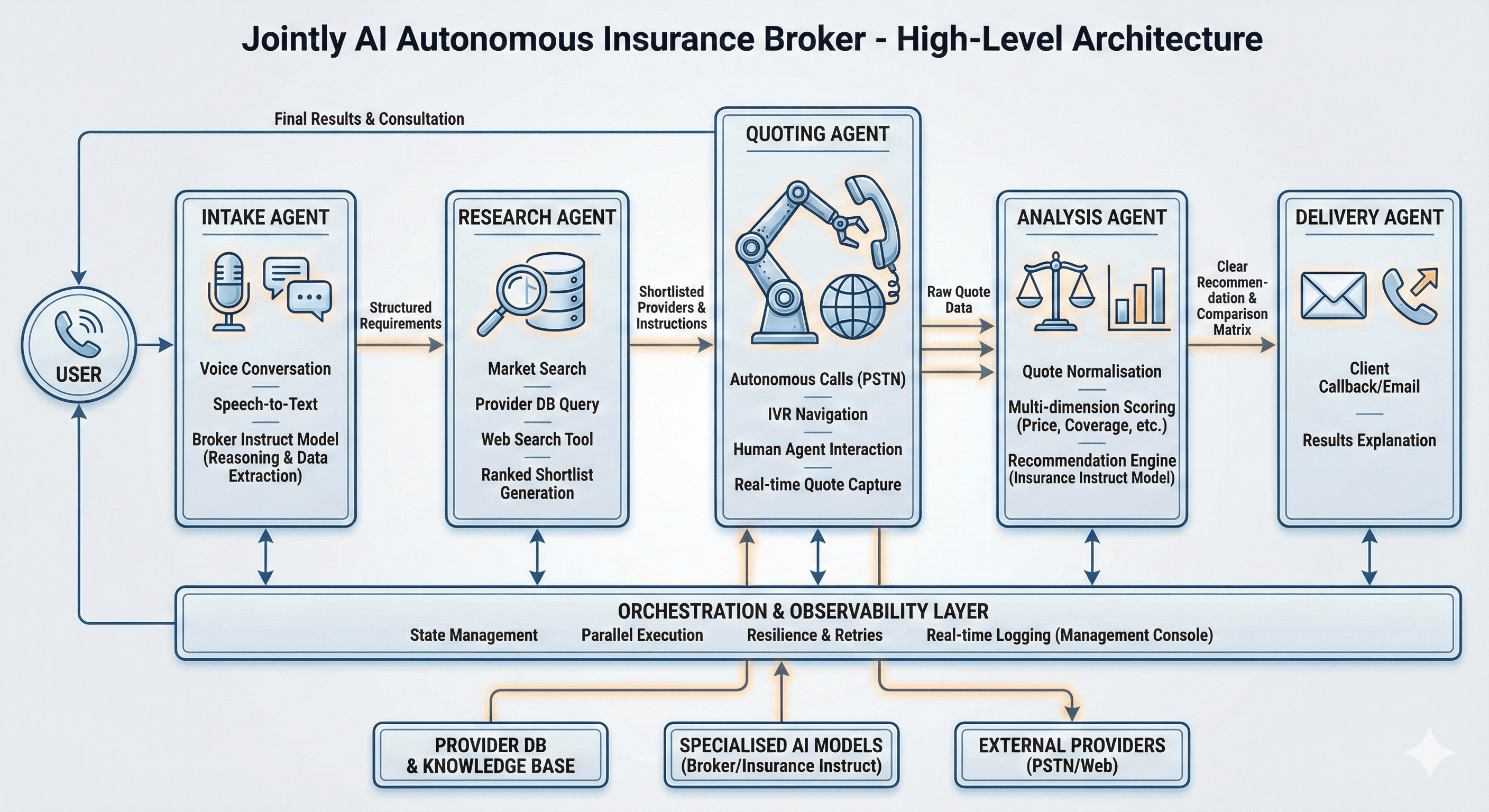
Most AI products are a single model behind a chat interface. Jointly AI Broker is fundamentally different. It's a pipeline of five specialised AI agents, each purpose-built for a distinct phase of the brokerage process. Each agent hands off structured data to the next, creating an autonomous workflow that mirrors - and improves upon - what a human broker does.
Intake Agent - Conducts a natural voice conversation to understand your insurance needs.
Research Agent - Searches the market and builds a ranked shortlist of providers.
Quoting Agent - Picks up the phone and calls each provider to obtain real quotes.
Analysis Agent - Compares every quote across multiple dimensions and generates a recommendation.
Delivery Agent - Calls you back (or emails you) with the results, clearly explained.
The entire pipeline runs autonomously. A user calls in, has a five-minute chat, and roughly 45 minutes later receives a comprehensive comparison of 10+ real quotes with a clear recommendation. No forms. No hold music. No spreadsheets.
Intake: A Conversation, Not a Form
The first thing users experience is the Intake Agent - and we put enormous effort into making it feel like talking to a knowledgeable broker, not filling out an online form.
Under the hood, the Intake Agent combines real-time speech-to-text, natural text-to-speech, and our Jointly Broker Instruct v1 model as its reasoning engine. But what makes it special is how we leverage function-calling capabilities to extract structured data from natural conversation.
When a user says "I've got a 2019 Golf, been driving about fifteen years, no claims", the agent doesn't just transcribe that. It simultaneously extracts `vehicle_make: Volkswagen`, `vehicle_model: Golf`, `vehicle_year: 2019`, `driving_experience: 15 years`, and `claims_history: none` - each with a confidence score. If any field falls below a certain confidence threshold, the agent naturally asks for clarification.
The questionnaire itself is dynamic. Auto insurance needs 25+ fields. Home insurance needs 30+. Life, health, business, travel - each has its own structured questionnaire. But the user never sees a questionnaire. They just have a conversation, and the agent steers it to cover everything that's needed, adapting to what the user offers naturally versus what needs to be explicitly asked.
The agent also handles the messy reality of real conversations: vague answers ("I think it's worth around 200k?"), mid-conversation changes ("Actually, I also need contents insurance"), and interrupted sessions that can be resumed later.
Research: AI With Tools, Not Just Text
The Research Agent demonstrates something we believe is critical to useful AI systems: giving models the ability to act, not just reason.
When the Research Agent receives the structured requirements from intake, it doesn't just generate text about insurance providers. It uses Jointly's insurance-specialised models tool-use capabilities to actively research the market:
- query_provider_db - Searches our curated database of insurance providers, filtered by insurance type, region, and eligibility criteria
- search_web - Performs live web searches for providers we might not have catalogued
- check_fca_register - Verifies that every recommended provider is properly authorised by the Financial Conduct Authority
- estimate_vehicle_value - Looks up current market valuations for accurate coverage recommendations
- geocode_postcode - Determines risk zones and regional pricing factors
The agent then scores each provider using a formula that considers relevance match, price reputation, quality rating, historical quote success rate, alignment with user preferences among other parameters. The output is a ranked shortlist of 5-15 providers with full contact details, operating hours, and - crucially - IVR navigation instructions.
That last point matters more than you'd think. It's the bridge to what comes next.

Quoting: AI That Makes Phone Calls
This is where most of the value lies. The Quoting Agent actually picks up the phone, dials insurance providers, navigates their automated phone menus, waits for a human agent, introduces itself as calling on behalf of the client, answers all the provider's underwriting questions, and captures the quote details - completely autonomously.
Each outbound call follows a structured flow:
1. Dial the provider via PSTN
2. Navigate the IVR using pre-mapped instructions from our provider database (press 1 for new quotes, press 3 for motor insurance...) as well as leveraging reasoning capabilites where needed, such as when IVR options change
3. Wait on hold for a human agent (with configurable timeouts)
4. Introduce and request a quote, transparently identifying as a broker acting on the client's behalf
5. Answer underwriting questions by pulling from the structured data captured during intake
6. Extract quote details in real-time using function calling: premium amounts, excess levels, coverage inclusions, exclusions, optional extras, and reference numbers
The agent runs up to four concurrent calls, processing the entire shortlist in roughly 35-45 minutes. Compare that to a human spending an entire afternoon on the phone.
What makes this technically challenging is the combination of real-time voice AI with structured data extraction. The agent needs to simultaneously maintain a natural conversation with a human insurance agent while accurately capturing financial details with zero tolerance for error. A misheard premium or a confused excess amount would undermine the entire comparison.
We handle this through Jointly's insurance-specialised models function-calling capability with strict field validation. When the agent hears "The annual premium would be four hundred and thirty-two pounds with a two hundred and fifty pound voluntary excess", it calls `capture_quote_field` for each value, and the system validates the extracted data against expected ranges before accepting it.
Analysis: Where the Best Model Earns Its Keep
Quote comparison sounds simple until you try to do it properly. Two quotes are never directly comparable. One includes legal expenses cover but charges more. Another has a lower premium but a higher excess. A third includes breakdown cover that the others offer as a paid add-on.
This is where we deploy Jointly Insurance Instruct v1 - our most capable model - as the Analysis Agent. Its job is to normalise every quote to an apples-to-apples basis, then score them across five weighted dimensions:
- Price - Annual premium normalised for payment frequency and included extras
- Coverage breadth - Count and value of covered items and included features
- Excess levels - Both compulsory and voluntary, and what they mean in practice
- Included extras - Breakdown/claim cover, legal expenses, courtesy car/alternative lodging or any others that apply
- Brand and reliability - Provider ratings and claims satisfaction data
The weighting adapts to what the user told us matters to them. A price-focused user sees price weighted higher. Someone who prioritises comprehensive coverage sees the analysis optimise for that. The model generates a full coverage comparison matrix and writes a clear, jargon-free rationale for its top pick, runner-up, and budget option.
This is the kind of reasoning task where model capability directly translates to user value. A weaker model might miss that Provider A's "included legal expenses cover" saves the user the 30 pounds per year that Provider B charges for it as an add-on, changing which option is actually cheapest. Our Jointly insurance-specialised reasoning models' depth and constraint-trained agents catch these nuances consistently.
Delivery: Closing the Loop
The final step brings everything back to the user. Our Delivery Agent calls the user back (or sends a detailed email, based on their preference) and walks through the results.
The voice callback is designed to be concise and clear: here's our top recommendation and why, here's a comprehensive alternative, here's the budget option, and here are the key differences you should know about. The agent answers follow-up questions and offers to send a full written comparison by email.
The email includes a complete comparison table, coverage matrix, and the rationale for each recommendation - everything needed to make a confident decision.
The Orchestration Layer
Tying five autonomous agents together into a reliable pipeline requires serious orchestration. We built ours on accounting for:
- Deterministic state transitions - Every request follows a defined path through the pipeline, with clear rules for retries, failures, and edge cases
- Parallel execution - Multiple quoting calls run concurrently, and multiple user requests process simultaneously
- Resilience - If a call drops, it redials. If an agent errors, it retries. If a provider is unreachable, the pipeline continues with the remaining quotes
- Full observability - Every state transition, every agent action, every tool call is logged and visible in our management console in real-time
Insurance Broker Operators can watch live transcripts of calls in progress, see the pipeline status for every request, monitor queue depths, and intervene manually if needed. In practice, intervention is rarely needed - but having complete visibility builds the confidence needed to let AI systems operate autonomously.
Key Takeaways
- Specialisation beats generalisation. If you run a specialised function at a business and use generic, off-the-shelf agents and LLMs expect generic behaviour that looks fine in pilots but that fails compliance gates into Production. Your industry guidelines, strict compliance policies and regulatory requirements cannot simply be encoded in a few hundred lines of prompt. Simples. Our proposition has always been that a single monolithic, general-purpose AI trying to do everything would be fragile and mediocre. Purposely trained agents are dramatically more reliable. This is what we have been building at Jointly across Claims and other Insurance-related operational processes.
- Tool use is the unlock for getting things done. The difference between an AI that talks about insurance and an AI that brokers insurance is tool use. Database queries, web searches, phone calls, financial calculations - these capabilities transform LLMs from conversational novelties into autonomous systems that deliver real value.
- Confidence scoring matters. Every piece of extracted data carries a confidence score. When confidence is low, the system asks for clarification rather than guessing. This simple principle prevents error propagation through the pipeline.
- Transparency builds trust. The Quoting Agent identifies itself as an AI broker on every call. The management console shows every action the system takes. Users receive clear rationales for every recommendation. When AI systems are transparent about what they are and what they're doing, trust follows naturally.
What's Next
We're actively expanding the types of insurance Jointly AI Broker can handle, improving our provider database coverage, and working on renewal management - automatically re-quoting before your policy expires to ensure you always have the best deal.
The broader vision at Jointly AI is to apply this multi-agent pipeline pattern to other domains where consumers are underserved by existing comparison tools, and where insurers carry extraordinary operational costs. Insurance was our starting point because the pain is acute and the process is well-defined. But anywhere that getting the best deal requires making phone calls, comparing complex options, and understanding fine print - that's where autonomous AI brokerage can help.
Jointly AI is building autonomous AI systems that work on behalf of consumers and insurers. To learn more or request early access to Jointly AI Broker, visit getjointly.ai.